Many electrical and mechanical parts need both metal and plastic: a conductive terminal held in an insulating body, or a threaded insert in a housing. Insert moulding makes that combination in a single moulding step instead of assembling it afterwards.
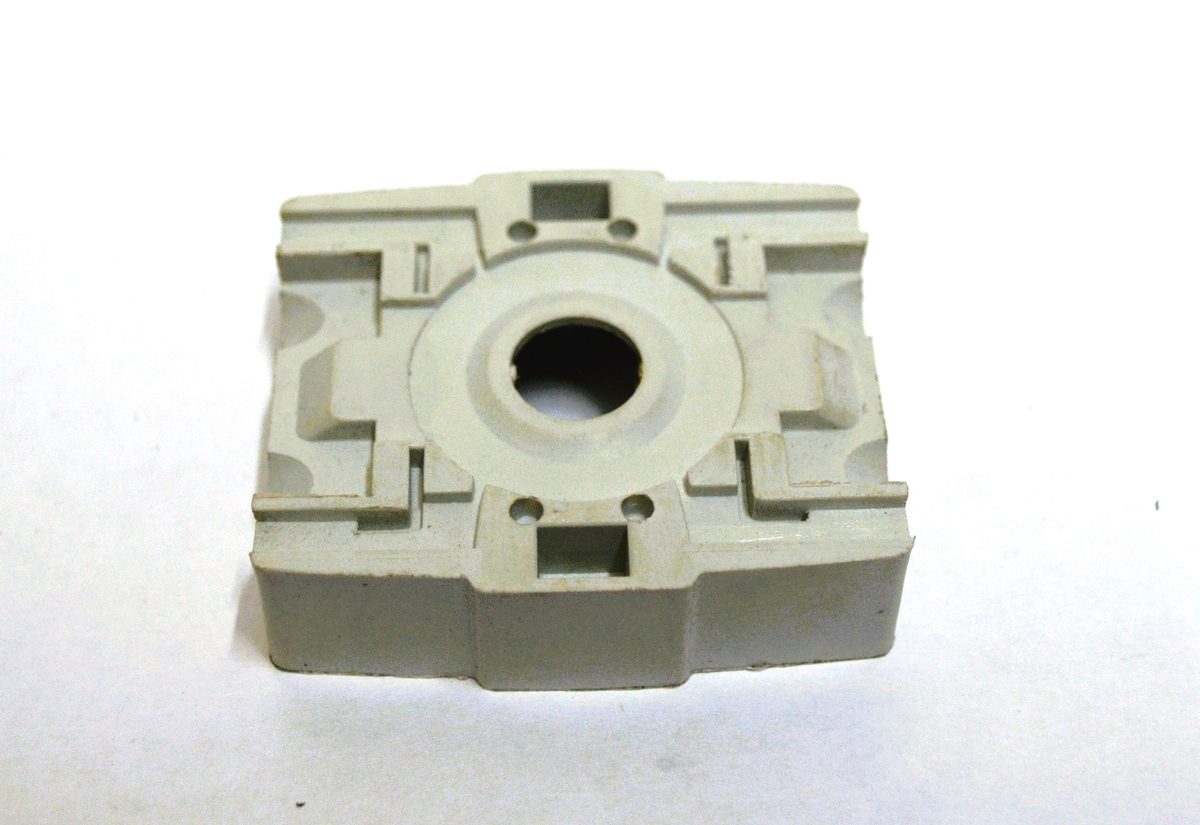
Injection-moulded component made by Voltkon in India.
What is insert moulding?
In insert moulding, a pre-made component, usually a stamped metal part, a pin or a threaded bush, is placed in the mould before injection. Molten plastic then flows around it and locks it in place as it solidifies. The result is one integrated part with no separate assembly step.
Why OEMs use it
- Fewer parts and operations: no press-fitting, heat-staking, screws or adhesives.
- Stronger retention: the plastic encapsulates knurls, holes and undercuts on the insert, giving pull-out and torque resistance that press-fits cannot match.
- Built-in insulation: conductive paths are sealed in insulating material, which suits terminals, contacts and connector bodies.
- Repeatable positioning: the insert is located by the mould, so its position relative to plastic features is controlled every shot.
Design rules that decide quality
- Design the insert for the mould. Add features the plastic can grip (holes, knurls, bends) and surfaces the mould can clamp to seal against flash.
- Control insert tolerances. Inserts that vary in size cause flash or crush. Stamped inserts with consistent flatness and burr direction make moulding far more stable.
- Keep wall thickness even around the insert to limit sink, voids and stress cracking as the plastic shrinks onto the metal.
- Consider preheating larger metal inserts so the melt does not freeze too fast at the interface.
- Choose the material for the duty. Engineering thermoplastics suit most housings. Thermosets suit parts that face high temperature or arcing, such as switchgear components.
Why it helps to stamp and mould under one roof
Most insert-moulding problems start with the insert: burrs, dimensional drift, or plating that is not suited to moulding temperatures. When the same supplier makes the stamped insert and the moulded part, tolerance stack-ups are designed together and problems are fixed at the source instead of argued over between two vendors.
Insert moulding at Voltkon
Voltkon runs plastic injection moulding with an in-house tool room, insert moulding, and engineering thermoplastics and thermosets, alongside precision stamping in the same group. See our plastic moulding capability and stamping capability, or send us your part for a quote.
