A progressive die can turn a coil of strip into finished parts at one part per press stroke. It is also the most expensive tool option up front. For OEM buyers, the real question is not whether progressive stamping is good, but at what volume and part complexity it beats the alternatives.
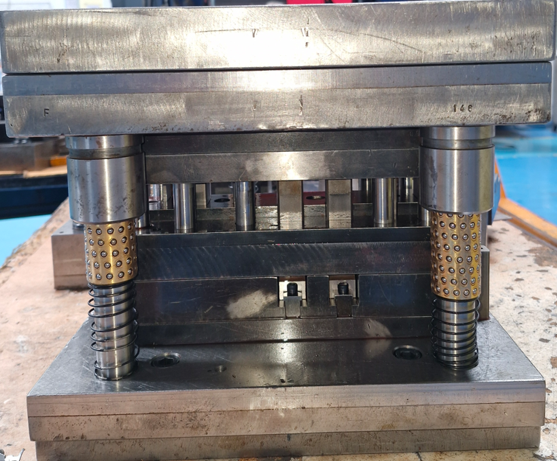
Progressive press tool built in Voltkon's in-house tool room.
How a progressive die works
In a progressive die, a metal strip feeds through a series of stations inside one tool. Each press stroke performs a different operation at each station: piercing, notching, forming, coining, bending. The strip advances one pitch after every stroke. Pilots locate the strip precisely at each station, and the finished part is cut free at the last station. Every stroke produces a complete part.
The alternatives
- Single-stage (line) tools: one operation per tool, with the part moved between presses. Cheap tooling, but more handling and labour per part.
- Compound dies: pierce and blank in one stroke. Very flat, accurate blanks, but limited forming.
- Transfer dies: the part is separated early and moved between stations by fingers. Suited to large or deep-drawn parts that cannot stay on a carrier strip.
When a progressive die pays off
The tooling cost is higher because the tool is longer, more complex and needs careful strip-layout design. That cost is repaid through a lower piece price. A progressive die usually makes sense when:
- Volumes are steady and high. Annual demand runs to tens of thousands of parts or more, over several years.
- The part needs several operations. Combining five or six operations in one tool removes handling, work-in-progress and repeated set-ups.
- Repeatability matters. Pilot location keeps feature-to-feature position consistent from part to part, which is valuable for electrical contacts and terminals.
- The part is small to medium in size and can stay attached to a carrier strip until the final cut-off.
For prototypes, short runs or parts still changing in design, single-stage tools or laser-cut blanks with simple forming are usually the better choice until the design is frozen.
What drives the economics
- Strip layout and material utilisation: nesting and pitch decide how much of each coil becomes scrap. On copper and brass parts this is often the biggest cost lever.
- Station count: each extra station adds tool length and cost. Good design combines operations without risking tool life.
- Press size and speed: the tool must suit the tonnage and bed size available.
- Tool maintenance: sharpening, spare punches and quick repair keep the line running. An in-house tool room shortens downtime.
Questions to ask your stamping supplier
- Who designs and builds the tool, and who owns it?
- How is the strip layout optimised for material yield?
- What is the planned maintenance interval and spares strategy?
- How are first-off parts measured and approved?
Progressive stamping at Voltkon
Voltkon designs and builds progressive tooling in its own tool room and runs precision stampings in steel, stainless steel, aluminium, copper and brass on 5 to 80 tonne presses, under ISO 9001. See our sheet metal stamping capability, or share your part drawing and annual volume for a quote.
